
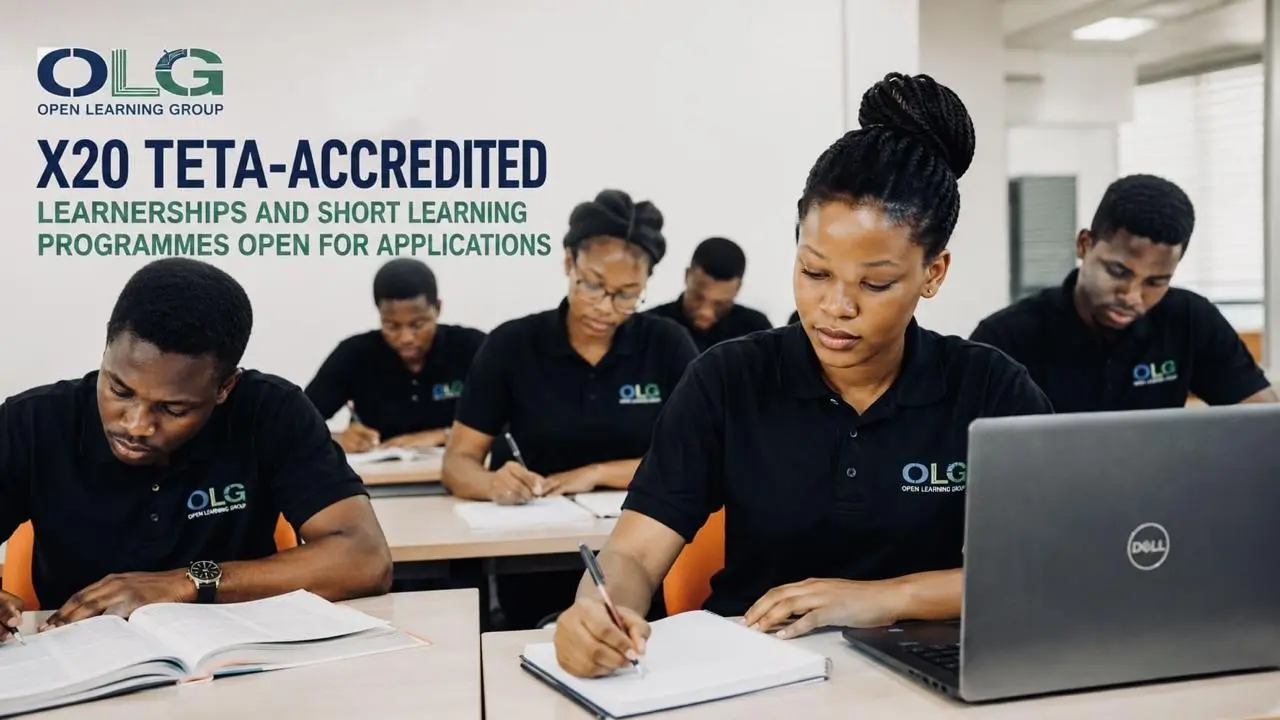
Open Learning Group (OLG) is offering learning opportunities in areas connected to logistics, supply chain management, procurement and project management, giving prospective learners an opportunity to explore career-focused education and skills development.
The opportunity is particularly relevant to people interested in the transport and logistics sector, where practical skills and industry knowledge can play an important role in building a career.
The programmes associated with this opportunity include TETA-related learning, learnerships, skills programmes and short learning programmes. Applicants should understand that these types of programmes are not necessarily the same as one another. They can have different admission requirements, funding arrangements, learning structures and outcomes.
Open Learning Group describes itself as an accredited private higher education institution with a focus on online higher education, particularly in logistics and supply chain management. The institution also delivers learnerships, skills programmes and short learning programmes through contact-based learning arrangements.
Related Opportunities 2026
- Funding Bursaries
- Youth Opportunities
- Internship Programme
- Learnership Programme
- Online Courses
- Government Education Updates
What Are the X20 TETA-Accredited Opportunities?
The X20 opportunity refers to a programme announcement indicating 20 opportunities connected to TETA-accredited learning and short learning programmes.
TETA, the Transport Education Training Authority, is responsible for skills development within South Africa’s transport sector. Its areas of operation include road freight, road passenger transport, rail, maritime, freight handling, forwarding and clearing, taxi and aerospace-related activities.
For learners, this means that training connected to the transport sector can provide exposure to areas that support the movement of people and goods, supply chains and business operations.
However, applicants should not assume that every programme advertised under a TETA-related opportunity has identical requirements. The exact programme, qualification or skills intervention should always be checked before an application is submitted.
About Open Learning Group
Open Learning Group has built its education offering around logistics, supply chain management and related areas.
Its programmes include logistics and supply chain management, procurement management, project management and short learning programmes. The institution also provides learning opportunities for organisations looking to develop their employees.
This makes the organisation particularly relevant to applicants who are considering careers in logistics and supply chain-related fields.
The transport and logistics sector requires people with different skills, including administration, procurement, planning, warehouse management, transportation coordination, project management and supply chain knowledge.
A learning programme can therefore be useful as part of a broader career-development plan.
What Is TETA?
The Transport Education Training Authority is one of South Africa’s Sector Education and Training Authorities.
TETA supports skills development in different parts of the transport sector and works with employers, training providers and other stakeholders to improve access to relevant skills.
Its learning programmes include workplace-based interventions such as learnerships, apprenticeships, internships and skills programmes.
A learnership is particularly important to understand because it is not simply a classroom course. TETA describes a learnership as a period of workplace-based learning that culminates in an occupational qualification or part qualification.
This workplace component is one of the key features that separates a learnership from many ordinary short courses.
Learnerships vs Short Learning Programmes
Applicants often use the terms “learnership” and “short course” interchangeably, but they are not necessarily the same.
A learnership combines structured learning with workplace experience. Depending on the programme, learners may receive theoretical training while also gaining practical experience in an appropriate workplace environment.
A Short Learning Programme, on the other hand, generally focuses on a particular area of knowledge or skill. It may be useful for someone who wants to develop a specific competency without immediately pursuing a longer qualification.
The right option depends on the applicant’s career objectives, previous education and the requirements of the specific programme.
Before applying, applicants should therefore read the programme information carefully instead of relying only on the word “learnership” in an advertisement.
Who Can Consider Applying?
The opportunity may be relevant to South Africans who are interested in developing skills related to transport, logistics, procurement, supply chain management and project management.
Potential applicants may include:
- Young people exploring career options after school
- Individuals interested in logistics and supply chain careers
- People looking to develop workplace skills
- Employees seeking additional training
- Applicants interested in procurement
- People considering project management as a career path
- Individuals interested in transport-sector opportunities
- Employers looking for skills-development solutions for staff
However, meeting one of these descriptions does not automatically mean that an applicant qualifies.
Eligibility depends on the specific programme and its requirements.
Eligibility Requirements
There is no single eligibility requirement that applies to every Open Learning Group programme.
The requirements can vary according to the programme type, qualification level, funding arrangement and intended group of learners.
Applicants should check the following before submitting an application:
Educational background
Some programmes may require a particular school qualification or previous level of study.
Applicants should make sure that they meet the academic requirements before selecting a programme.
Work experience
Some workplace-based programmes may have requirements connected to employment or workplace participation.
If work experience is required, applicants should not provide inaccurate information.
Funding
Funding is an important consideration for learnership applicants.
Not every learnership operates as an individual course application. Some learnerships are funded or sponsored by companies or other organisations.
Applicants should therefore establish whether the opportunity is intended for direct individual applications or whether an employer or funder must be involved.
Programme-specific requirements
The most reliable eligibility information is the information provided for the particular programme.
Applicants should not assume that requirements from another learnership automatically apply to this opportunity.
Important Information About Learnership Funding
One of the most important points for prospective learners is understanding how learnerships are funded.
Open Learning Group’s current information indicates that its Further Education and Training learnerships must be funded by a company or direct funder.
This means an individual should not automatically assume that submitting a general application to OLG guarantees placement into a learnership.
People who are already employed and interested in a learnership may wish to discuss training opportunities with their employer’s Human Resources or Training Department.
The funding structure can influence who is eligible to participate, how learners are selected and how the workplace component is organised.
How to Apply
Applicants interested in the available Open Learning Group programmes should use the official application process.
Before starting an application, make sure that you have selected the correct programme and understand what is being offered.
Application Link
Official Open Learning Group application portal:
https://olg.co.za/apply-now/
Applicants should carefully complete the information requested during the application process.
Application Tips
A carefully prepared application can help prevent avoidable mistakes.
1. Check your personal information
Make sure your full name, surname, telephone number and email address are correct.
Incorrect contact information can create problems if the institution needs to communicate with you.
2. Read the programme requirements
Do not select a programme based only on its title.
Read the description and determine whether the programme matches your education, experience and career plans.
3. Prepare your documents
Have the documents required for the particular programme available before starting the application.
Only submit genuine and accurate information.
4. Do not provide false qualifications
Applicants should never claim qualifications or experience they do not have.
False information can result in an application being rejected and may create further problems later in the selection process.
5. Understand the funding arrangement
If the opportunity involves a company-funded learnership, applicants should understand who is responsible for funding and workplace participation.
This is especially important because a learnership is not necessarily the same as an individually funded short course.
6. Keep your contact details active
After submitting an application, continue checking the email address and telephone number used during the application.
Important communication may be sent using the contact information provided.
Career Insights: Logistics and Supply Chain Management
Logistics and supply chain management are important areas in the South African economy.
Businesses need people who understand how products, materials and information move through supply chains.
Depending on their qualifications and experience, people working in this broader field can be involved in areas such as procurement, inventory, warehousing, transportation, planning, supplier management and administration.
Training can help learners understand the principles behind these activities.
However, applicants should have realistic expectations.
Completing a learnership or short learning programme does not automatically guarantee employment. Employment depends on many factors, including qualifications, skills, experience, available vacancies and employer requirements.
The strongest approach is to view training as one part of a longer career-development journey.
Career Opportunities to Explore
People who develop logistics and supply chain skills may eventually explore different career areas.
These can include:
- Logistics administration
- Supply chain coordination
- Procurement support
- Warehouse administration
- Inventory control
- Transport coordination
- Operations support
- Project administration
- Supply chain planning
The exact career options available to an individual depend on their qualifications, experience and the requirements of employers.
Additional education and workplace experience can also help individuals build their professional profile over time.
Why Accreditation Matters
Accreditation is an important consideration when choosing a training opportunity.
Applicants should distinguish between a training provider claiming to offer a programme and a programme that has the appropriate approval or accreditation for the relevant qualification or learning intervention.
TETA maintains systems for verifying accredited providers and related qualifications.
This is particularly useful because training advertisements are frequently shared across social media platforms, messaging groups and community pages.
Applicants should be careful when they see claims such as “guaranteed job”, “guaranteed placement” or “guaranteed qualification”.
A legitimate learning opportunity should provide clear information about the programme, provider, requirements and application process.
Avoiding Application Scams
Applicants should also be alert to scams.
A genuine opportunity should not require applicants to provide passwords, banking PINs or other highly sensitive information.
Be particularly cautious when someone contacts you privately and claims to represent a training provider without being able to provide verifiable information.
Applicants should use the recognised application process and avoid sending money to individuals who promise guaranteed placement.
The presence of a programme advertisement on social media does not automatically mean that the person sharing it is connected to the training provider.
Frequently Asked Questions
How many opportunities are included in the X20 opportunity?
The opportunity is described as X20, indicating 20 opportunities. Applicants should confirm the current intake and availability when submitting their application.
What does TETA stand for?
TETA stands for the Transport Education Training Authority. It is the SETA responsible for skills development within South Africa’s transport sector.
What industries does TETA cover?
TETA’s areas include transport-related sectors such as road freight, road passenger transport, rail, maritime, freight handling, forwarding and clearing, taxi and aerospace.
Are learnerships the same as short learning programmes?
No. A learnership includes a structured workplace-learning component and leads towards an occupational qualification or part qualification. Short Learning Programmes are generally more focused on specific knowledge or skills.
Can unemployed people apply?
Eligibility depends on the specific opportunity and funding arrangement. Applicants should carefully check whether the programme is open to unemployed individuals and whether an employer or funder must be involved.
Does applying guarantee acceptance?
No. Submitting an application does not guarantee admission, selection or placement.
Does completing the programme guarantee employment?
No. Training can provide skills and knowledge, but employment depends on factors such as qualifications, experience, vacancies and employer requirements.
Is there an application fee?
Applicants should check the application instructions for the particular programme before making any payment. Do not pay unofficial individuals who promise guaranteed placement.
What should applicants study before choosing a programme?
Applicants should consider their career interests, existing education, required skills and the type of work they eventually want to pursue.
When should applicants apply?
Applicants should submit their information as soon as possible when an intake is confirmed and available, while first checking the programme requirements and application information.
Updated Information
The information in this article has been prepared using programme information available at the time of publication.
Applicants should understand that learning opportunities can change. Programme availability, intake numbers, eligibility requirements, funding arrangements and registration periods may be updated by the relevant institution or funder.
For that reason, applicants should confirm the latest information before submitting their application.
This article does not promise admission, funding, a stipend, workplace placement or employment.
Final Thoughts
The X20 TETA-accredited learnerships and Short Learning Programmes provide an opportunity for people interested in developing skills connected to transport, logistics, supply chain management and related business functions.
The most important step is choosing a programme that matches your career goals and eligibility.
Applicants should take time to understand whether they are applying for a learnership, skills programme, short learning programme or higher education qualification. These opportunities can have different requirements and funding structures.
A strong application should contain accurate information, the required documents and a clear understanding of the programme being selected.
For applicants considering a career in logistics or supply chain management, developing relevant skills can be a useful part of building long-term career readiness.
