
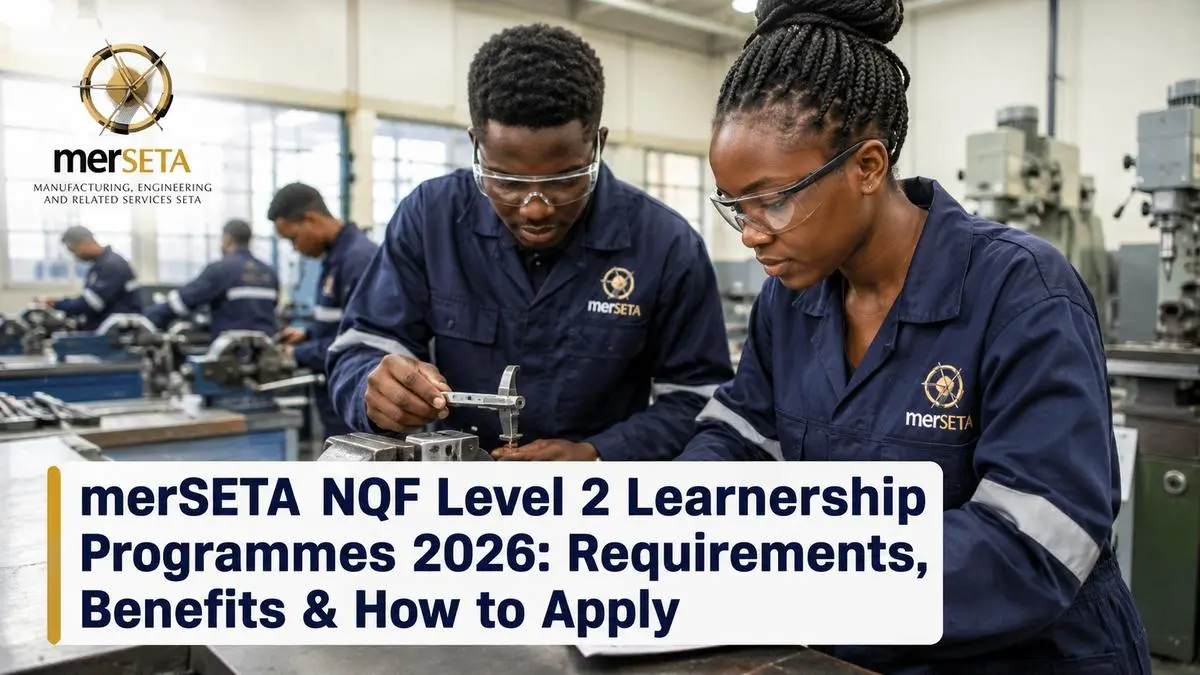
The merSETA NQF Level 2 Learnership Programmes 2026 offer an excellent opportunity for unemployed South Africans who want to build practical skills and begin a career in the manufacturing, engineering, and related industries. Learnerships combine structured classroom learning with valuable workplace experience, helping participants gain nationally recognised qualifications while developing the skills employers are looking for.
For many young people, a lack of work experience is one of the biggest barriers to employment. merSETA-accredited learnerships help bridge that gap by providing hands-on training under the guidance of experienced professionals. Participants not only improve their technical knowledge but also develop workplace skills such as communication, teamwork, problem-solving, and professionalism.
This guide explains the merSETA NQF Level 2 Learnership Programmes 2026, including eligibility requirements, benefits, application guidance, and career opportunities. Information in this article is based on publicly available guidance from the Manufacturing, Engineering and Related Services Sector Education and Training Authority (merSETA) and general learnership practices in South Africa.
Related Opportunities 2026
- Funding Bursaries
- Youth Opportunities
- Internship Programme
- Learnership Programme
- Online Courses
- Government Education Updates
What Is merSETA?
The Manufacturing, Engineering and Related Services Sector Education and Training Authority (merSETA) is one of South Africa’s Sector Education and Training Authorities established to promote skills development within key industrial sectors.
Working with employers, training providers, labour organisations, and government, merSETA supports initiatives that help address skills shortages across industries such as:
- Manufacturing
- Metal and engineering
- Automotive
- Plastics manufacturing
- Motor retail
- New tyre manufacturing
- Components manufacturing
- Retail motor services
Through accredited training programmes, bursaries, apprenticeships, internships, and learnerships, merSETA contributes to developing a skilled workforce capable of supporting economic growth.
Understanding NQF Level 2 Learnerships
The National Qualifications Framework (NQF) is South Africa’s system for classifying educational qualifications.
An NQF Level 2 Learnership is generally comparable to a Grade 10 level qualification. It provides foundational occupational knowledge and practical workplace skills for individuals entering technical or vocational careers.
Unlike traditional classroom education, a learnership allows participants to:
- Study theoretical modules.
- Complete practical workplace training.
- Gain industry exposure.
- Build employability skills.
- Work toward a nationally recognised qualification.
This combination of education and practical experience makes learnerships valuable for people entering the job market for the first time.
Purpose of the merSETA NQF Level 2 Learnership Programmes 2026
The 2026 programmes are designed to help participants develop industry-relevant skills that employers need. Depending on the employer and training provider, learners may receive training in areas such as:
- Basic engineering practices
- Manufacturing operations
- Machine operation
- Workshop safety
- Quality control
- Production processes
- Occupational health and safety
- Communication and workplace readiness
- Teamwork and customer service
Each programme follows an approved curriculum aligned with national occupational standards.
Who Should Apply?
The programmes are ideal for:
- Recent school leavers
- Unemployed South Africans
- Young people seeking work experience
- Individuals interested in engineering careers
- Applicants looking to improve their employability
- Candidates wishing to gain practical industry skills
Although many learnership opportunities target youth, individual employers may advertise positions for applicants from different age groups depending on operational requirements.
General Eligibility Requirements
Requirements vary depending on the employer advertising the learnership. However, applicants are commonly expected to meet requirements similar to the following:
- Be a South African citizen.
- Possess a valid South African ID.
- Meet the minimum educational requirement specified in the advertisement.
- Be willing to participate in both classroom and workplace training.
- Demonstrate an interest in engineering, manufacturing, or related industries.
- Be able to communicate effectively in English.
- Be available for the full duration of the programme.
Some employers may also request additional documentation, assessments, interviews, or medical fitness examinations where relevant to the role.
Applicants should always read the official vacancy carefully before submitting an application.
Educational Requirements
Educational requirements differ between employers and occupations.
Many NQF Level 2 opportunities may require one or more of the following:
- Grade 9
- Grade 10
- Grade 11
- Grade 12 (Matric)
Certain technical programmes may also recommend passes in:
- Mathematics
- Mathematical Literacy
- Physical Sciences
- Engineering Graphics and Design
- Technical Mathematics
- Technical Sciences
Meeting the minimum educational requirement does not guarantee selection, as employers may receive a high volume of applications.
Skills That Can Strengthen Your Application
While previous work experience is often not required, employers frequently value applicants who demonstrate:
- Good communication skills
- Positive attitude
- Willingness to learn
- Reliability
- Time management
- Problem-solving ability
- Teamwork
- Adaptability
- Basic computer literacy
- Strong work ethic
Showing enthusiasm for learning and following instructions can make a positive impression during the recruitment process.
Benefits of Joining a merSETA Learnership
Participating in a merSETA-supported learnership can provide several long-term advantages.
Nationally Recognised Qualification
Learners work towards an accredited qualification registered on South Africa’s National Qualifications Framework, helping strengthen future employment opportunities.
Practical Workplace Experience
One of the greatest benefits is exposure to real working environments where learners apply classroom knowledge to practical tasks under supervision.
Improved Employability
Employers often value candidates who already understand workplace expectations, safety procedures, and industry practices. Completing a learnership can strengthen a CV and demonstrate commitment to professional development.
Personal Development
Beyond technical training, participants often improve important workplace competencies such as:
- Communication
- Professional conduct
- Team collaboration
- Problem-solving
- Critical thinking
- Workplace ethics
These transferable skills are valuable across many industries.
Networking Opportunities
Working alongside experienced employees allows learners to build professional relationships that may support future employment opportunities and career growth.
Is There a Monthly Stipend?
Many employers offering merSETA-accredited learnerships provide a monthly training allowance or stipend to help learners with expenses such as transport and meals.
However, stipend amounts are not standardised by merSETA and differ between employers, funding arrangements, programme duration, and available budgets.
Applicants should refer to the specific learnership advertisement for information regarding any stipend, benefits, or additional support offered during the programme.
Why These Learnerships Matter
South Africa continues to face skills shortages in several technical and manufacturing occupations. Learnership programmes help address these challenges by preparing individuals with practical, industry-relevant competencies while creating pathways into employment.
For many participants, completing a learnership becomes the first step toward apprenticeships, artisan training, higher qualifications, or permanent employment within the manufacturing and engineering sectors.
Although employment after completion cannot be guaranteed, the knowledge, workplace experience, and recognised qualification gained through the programme can significantly improve future career prospects.
How to Apply for merSETA NQF Level 2 Learnership Programmes 2026
The application process for merSETA NQF Level 2 Learnership Programmes may differ depending on the employer, training provider, or organisation offering the opportunity. While merSETA supports skills development, many learnership vacancies are advertised and managed by accredited companies or training institutions rather than by merSETA directly.
To improve your chances of submitting a successful application, follow these steps.
Step 1: Find an Official Learnership Advertisement
Start by looking for current merSETA-accredited learnership opportunities on official employer websites, recognised job portals, or the official merSETA website. Always read the advertisement carefully to understand the requirements, closing date, and application instructions.
Pay attention to details such as:
- The qualification being offered
- Minimum education requirements
- Required documents
- Location of the learnership
- Programme duration
- Whether a stipend is offered
- Application closing date
Application link: https://www.merseta.org.za/merseta-learnerships/
Step 2: Prepare Your Documents
Most learnership applications require supporting documents. Having these ready before applying can save time and reduce the risk of missing the deadline.
Commonly requested documents include:
- A comprehensive and updated Curriculum Vitae (CV)
- Certified copy of your South African ID
- Certified copies of your educational certificates or latest school results
- Proof of residence (if requested)
- Driver’s licence (only if specified)
- Any additional certificates relevant to the programme
Ensure your documents are clear, legible, and certified if required in the advertisement.
Step 3: Complete the Application Correctly
Whether applying online or by email, complete every section accurately. Double-check your personal details, contact information, and document uploads before submitting.
Avoid submitting incomplete applications, as they are often not considered during the shortlisting process.
Step 4: Submit Before the Closing Date
Late applications are generally not accepted. Submit your application well before the deadline to avoid problems caused by internet issues or missing documents.
After submitting, keep a copy of your application and any confirmation email for your records.
Application Tips to Improve Your Chances
Competition for learnerships can be high, so presenting yourself professionally is important.
Tailor Your CV
Instead of using the same CV for every opportunity, update it to highlight relevant education, technical subjects, volunteer work, leadership activities, and any practical experience.
Keep your CV concise, organised, and free from spelling mistakes.
Write a Professional Email
If applications are submitted by email, use a professional email address that includes your name.
Your email should be polite, brief, and include:
- The position you are applying for
- Your full name
- Your contact number
- A note confirming that supporting documents are attached
Check Your Contact Details
Many applicants miss opportunities because they provide incorrect phone numbers or email addresses.
Before submitting your application, confirm that:
- Your cellphone number is correct.
- Your email address is active.
- Your voicemail is available if employers try to call.
Keep Copies of Everything
Store copies of:
- Your CV
- Certificates
- Identity document
- Application forms
- Confirmation emails
This makes it easier if you are invited for an interview or asked to resubmit documents.
Common Mistakes Applicants Should Avoid
Many applications are unsuccessful because of avoidable errors rather than a lack of qualifications.
Common mistakes include:
- Applying after the closing date
- Uploading incomplete documents
- Providing incorrect contact information
- Ignoring the eligibility requirements
- Using an outdated CV
- Sending blurred or unreadable certified copies
- Applying for positions without reading the full advertisement
Taking a few extra minutes to review your application can make a significant difference.
What Happens After Applying?
The recruitment process varies depending on the employer.
If you are shortlisted, you may be contacted for one or more of the following:
- Telephone screening
- Interviews
- Aptitude assessments
- Practical evaluations
- Medical examinations (where applicable)
- Verification of qualifications
Not all applicants will receive feedback due to the large number of applications received.
If you are not selected, continue applying for other learnerships and use each application as an opportunity to improve your CV and interview skills.
Career Opportunities After Completing the Programme
Completing a merSETA NQF Level 2 Learnership does not automatically guarantee permanent employment. However, it can provide valuable experience and improve your competitiveness in the labour market.
Depending on your field of study and employer needs, graduates may pursue opportunities such as:
- Engineering Assistant
- Manufacturing Operator
- Production Assistant
- Machine Operator
- Assembly Worker
- Workshop Assistant
- Quality Control Assistant
- Logistics and Warehouse Support
- Technical Support Assistant
- Apprentice (subject to meeting additional requirements)
Some participants may also continue their studies by progressing to higher NQF qualifications or specialised artisan training programmes.
Building a Long-Term Career in Engineering and Manufacturing
South Africa’s engineering and manufacturing sectors continue to require skilled workers who can adapt to modern production technologies and workplace standards.
A learnership is only the beginning of your career journey. To improve your long-term prospects:
- Continue learning through additional qualifications.
- Develop strong communication and teamwork skills.
- Stay informed about industry trends.
- Build a professional network.
- Maintain a positive work ethic.
- Be willing to relocate if opportunities arise.
Employers often value individuals who demonstrate continuous learning and a commitment to professional growth.
Staying Updated on Future Learnership Opportunities
New learnership opportunities become available throughout the year as employers receive funding approvals and identify workforce needs.
Applicants should regularly monitor official recruitment channels, accredited employers, and trusted career websites for announcements. Keeping your CV updated and your supporting documents ready will allow you to respond quickly when suitable opportunities are advertised.
Remaining proactive and applying only through official recruitment channels can help protect you from recruitment scams while increasing your chances of securing a genuine training opportunity.
Frequently Asked Questions (FAQs)
1. What is the merSETA NQF Level 2 Learnership Programme?
The merSETA NQF Level 2 Learnership Programme is a work-based learning opportunity that combines structured classroom training with practical workplace experience. It is designed to equip participants with foundational skills needed for careers in the manufacturing, engineering, automotive, and related industries.
2. Who can apply?
Eligibility depends on the employer offering the learnership. In most cases, applicants should:
- Be South African citizens.
- Meet the minimum educational requirement stated in the advertisement.
- Be willing to complete both theoretical and practical training.
- Submit all required supporting documents before the closing date.
Always refer to the official vacancy notice for programme-specific requirements.
3. Do I need work experience?
Most NQF Level 2 learnerships are intended for entry-level applicants, meaning previous work experience is generally not required. Employers are often looking for motivated individuals who are eager to learn and develop workplace skills.
4. Is there a monthly stipend?
Many employers provide a monthly training allowance to help cover expenses such as transport and meals. However, stipend amounts differ from one programme to another and are determined by the employer or funding arrangement.
5. Does completing a learnership guarantee permanent employment?
No. Completing a learnership does not guarantee permanent employment. However, it provides recognised training, practical work experience, and industry exposure that can improve your chances of securing future employment or progressing to higher-level training opportunities.
6. Where can I find official learnership opportunities?
Official opportunities are typically advertised on accredited employer websites, recognised recruitment platforms, and the official merSETA website. Always apply through trusted sources and be cautious of scams requesting payment for applications.
Final Thoughts
The merSETA NQF Level 2 Learnership Programmes 2026 offer an excellent opportunity for aspiring professionals to gain practical experience while working towards a nationally recognised qualification. These programmes are especially valuable for individuals who want to build a strong foundation in South Africa’s manufacturing and engineering sectors.
Success begins with careful preparation. Read every advertisement thoroughly, ensure you meet the eligibility requirements, submit all requested documents, and apply before the closing date. A professional CV, attention to detail, and a willingness to learn can help you stand out in a competitive application process.
As industries continue to evolve, skilled and adaptable workers remain in demand. Participating in a learnership can be the first step toward a rewarding long-term career, further studies, or specialised artisan training.
